Calumet Muffins

Calumet Muffins

A Recipe from The Calumet Book of Oven Triumphs! (1934)

About the Recipe

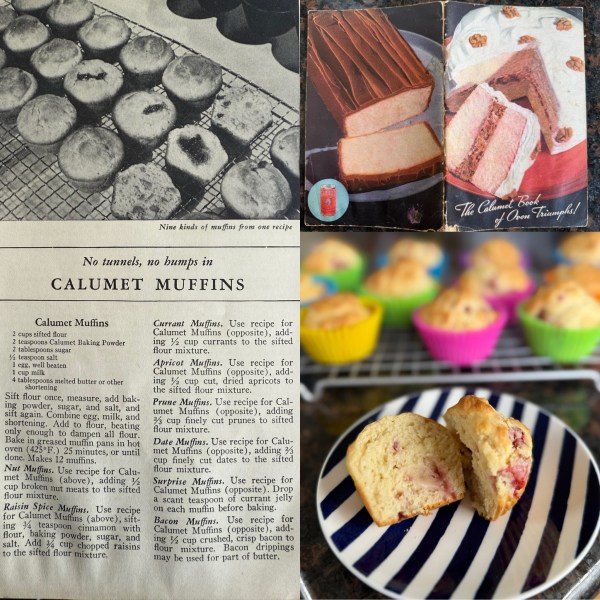
There’s nothing like a basic muffin recipe with loads of variations to have in one’s back pocket. This one is fabulous to have at the ready for whatever fun fillings you’d like to put inside. It’s more on the savory side than sweet, making it a perfect base recipe to play with.

A few quick notes about my variation:

  • Strawberries were on sale this week, so I used a cup of 1/4″ diced strawberries as the flavor profile. A quick toss in a little bit (less than a teaspoon) of flour kept them floating rather than sinking during baking.
  • If you’re going to use butter, make sure to let your milk and egg come to room temperature. This wouldn’t have been an issue in 1934, but certainly was in 2025. Oops. I ended up using vegetable oil, which worked just fine.
  • For the future, I’ll probably add a little bit of spice here. It’s a very plain muffin, which is great as a base, but not so exciting overall.

In the end, Maxx gave these a very enthusiastic thumbs up. Fresh out of the oven with a little bit of butter, they were absolutely divine.

About the book

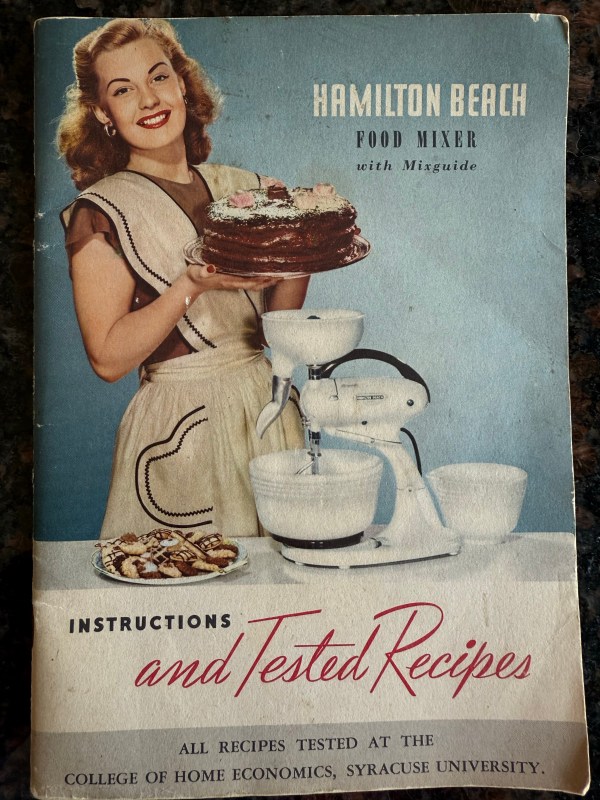
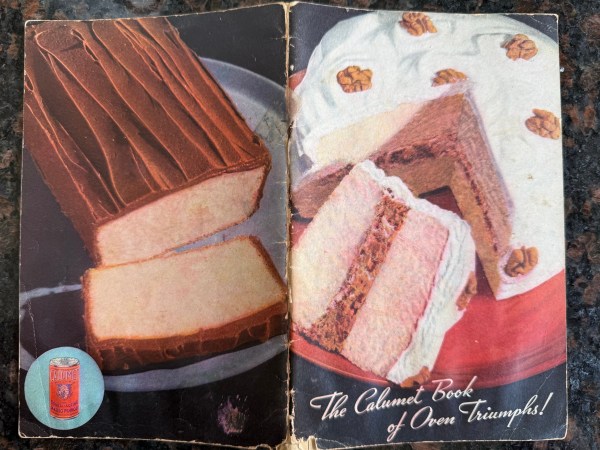
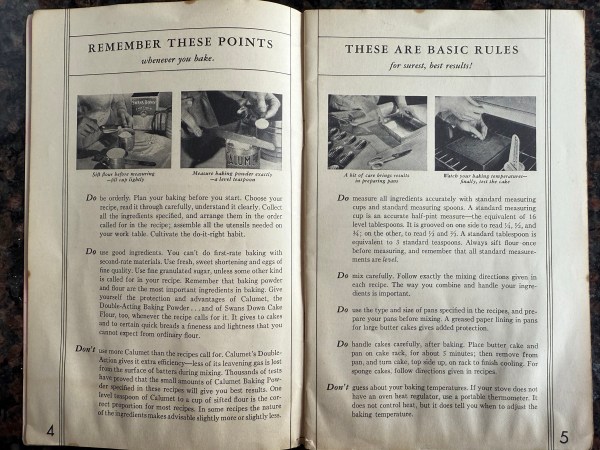
I’ve had this little booklet lurking in my collection for awhile. The Calumet Baking Powder company put out this little booklet a few times over the 1930’s and the recipes are great. They’re easy to follow, and designed to be delicious. After all, the better the recipe, the more times you’ll make it. And the more times you make it, the more baking powder you’ll use. *wink!*

I love the tips and tricks to help make sure that the home baker is successful. It brings everything down to earth and makes it all so simple. Enjoy Calumet’s art deco design and tips for success:

The Recipe!

Ingredients:

2 cups sifted flour
2 t baking powder
2 T sugar
1/2 t salt
1 egg, well beaten
1 cup milk
4 T melted butter or other shortening
1 cup 1/4″diced strawberries (optional)

Directions:

Sift flour once, measure, add baking powder, sugar, and salt, and sift again (or combine all dry ingredients in a bowl and whisk to combine). Combine egg, milk, and shortening. Add to flour, beating only enough to dampen all flour. Fold in fruit if using. Bake in greased muffin pans in hot oven (425*F) 25 minutes, or until done. Makes 12 muffins.

Lemon Crisp

Lemon Crisp

A Recipe from Favorite Recipes of America Desserts (1968)

About the Recipe

If you’ve been with my blog for awhile, you’ll know that I love a recipe that tricks me into making something fancy that I probably wouldn’t have tried otherwise. This time, it was a beautiful lemon curd.

This recipe is magnificent. It’s tart and crunchy and absolutely perfect with the whipped cream on top. It would make a great make-ahead for a dinner party. I re-heated it in the warming drawer in my oven. The hubs and I even nibbled on it the next day. How was it? Still good.

One important note on this recipe to make sure it’s successful: Make sure that you have your mise en place set up and ready to go before you start working on the stove. You will not have time (or hands) to measure as you go on this one.

About the book

This book is one in a set of 5. I actually found a different book out of this set first (Casseroles. Don’t judge, I’m a fan). When I saw the full set on the shelf in my favorite antiques store, I had to have it.

The books are like a nationwide community cookbook. The submissions are clearly folks’ favorites. Typically they’re easy to make and every one I’ve tried has turned out well. They’re truly a look into kitchen favorites during this time period.

The Recipe!

Ingredients:

6 T butter or margarine
3/4 cup brown sugar
1 cup sifted flour
3/4 t salt (divided)
1/3 cup flaked coconut
3/4 cup finely crushed saltine crackers
3/4 cup white sugar
2 T cornstarch
1 cup hot water
2 beaten egg yolks
1/2 t grated lemon peel
1/2 cup lemon juice

Directions:

Cream butter and brown sugar; add flour, soda, 1/2 teaspoon salt, coconut and crackers. Press half crumb mixture into 8 x 8 x 2-inch baking pan. Bake at 350*F for 10 minutes. 

In saucepan combine white sugar, cornstarch and remaining salt; gradually stir in water. Bring to boil, stirring constantly; boil about 2 minutes. Remove from heat; stir small amount of hot mixture into egg yolks. Return to pan. Bring to a boil, stirring constantly; remove from heat. Stir in lemon peel and juice gradually. Pour over baked crust; top with remaining crumb mixture. 

Bake at 350*F for 30 minutes or until lightly browned. Top with whipped cream. Yield: 8 servings

George Washington’s Cherry Treat

George Washington’s Cherry Treat

A Recipe from Favorite Recipes of America Desserts (1968)

About the Recipe

Here in the United States tomorrow is President’s Day! President’s Day is officially celebrated on the third Monday in February. It’s so situated because that day is always between President Abraham Lincoln’s Birthday (February 12th) and President George Washington’s Birthday (February 22nd). What better way to celebrate than with a cherry treat specifically for President Washington?

In truth, I was looking specifically for a cherry treat for a friend who’s “suffered” through some other fruit desserts, all while not-so-subtly hinting that cherry was her favorite. It had been a minute since I looked through this particular set of recipe books. There were several different options, but I was actively looking for something like a cobbler.

I love cobblers. They’re called “cobblers” because of the resemblance to cobblestone streets created by dropping the biscuit dough on the top. There are a few regional variations, but by and large it’s fruit filling topped with a sweet or savory biscuit. Yum!

Only three notes on this one:
1. I used frozen cherries that I let thaw on the counter and that worked just fine. If you wanted a real shortcut, grab your favorite cherry pie filling and call it a day. That said – this filling is SO GOOD.
2. Add a little spice to the biscuit dough. Some cinnamon or nutmeg will do. It adds just a little more depth to the overall taste.
3. Definitely serve this hot, but let it sit for just a few minutes out of the oven to truly set. Also a little scoop of vanilla ice cream will go a long way to elevating.

About the book

This book is one in a set of 5. I actually found a different book out of this set first (Casseroles. Don’t judge, I’m a fan). When I saw the full set on the shelf in my favorite antiques store, I had to have it.

The books are like a nationwide community cookbook. The submissions are clearly folks’ favorites. Typically they’re easy to make and every one I’ve tried has turned out well. They’re truly a look into kitchen favorites during this time period.

The Recipe!

Ingredients:

2/3 cup sugar
2 T cornstarch
1 cup cherry juice
2 1-lb. cans of red tart cherries, drained (or 2 lbs. frozen cherries thawed and drained)
1 T butter or margarine
1/4 t cinnamon
Few drops of red food coloring

Topping:
1 cup sifted flour
2 T sugar
2 t baking powder
1/2 t salt
3 T shortening
1/2 cup milk
2 T sugar

Directions:

Combine sugar and cornstarch; add cherry juice and cook until thick. Stir in cherries, butter, cinnamon and food coloring. Pour into 8-inch square pan.

Topping:
Sift dry ingredients; cut in shortening. Add milk gradually. Mix well with fork. Drop by tablespoonfuls onto cherry mixture. Sprinkle sugar over pastry. Bake at 400*F for 30 minutes. Serve hot. Yield: 6-8 servings

Snickerdoodles

Snickerdoodles

A Recipe from Good Housekeeping’s Book of Cookies (1958)

About the Recipe

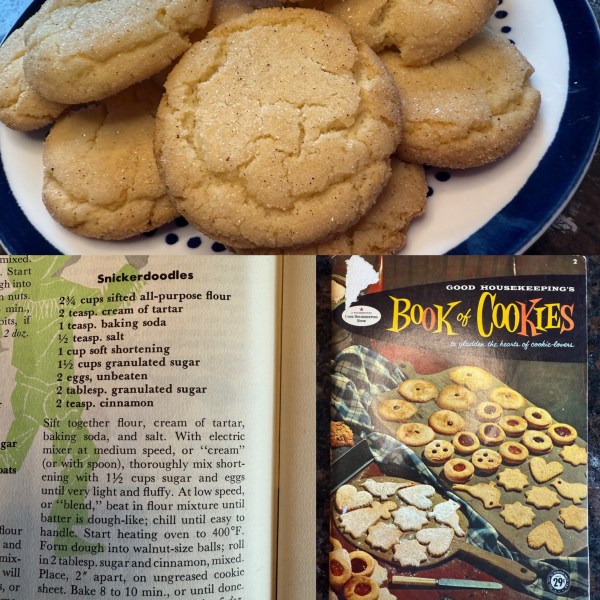
My team at work gathered together this past week. I wanted to bring something that made the meeting a little bit more sweet. This simple snickerdoodles recipe seemed just the right thing!

The combination of cream of tartar and shortening vs. baking powder and butter means that these are super crispy and airy cookies. Those who’ve read this blog for a bit know that I can get a bit nerdy about the science of it all. Baking powder, while acidic which will react with the baking soda, it also includes a basic element. Cream of tartar is pure acidity. When it comes in contact with the baking soda during baking it creates more air and bubbles in the cookies. The shortening, meanwhile, has a higher melting point than the butter. This helps the cookies to maintain those bubbles and crisp along with the shape and height. Delightful.

All of that being said, if you don’t have cream of tartar handy, you can absolutely substitute baking powder. Same with the shortening – as always, a fat is a fat is a fat is a fat. Butter will give this cookie a bit more tenderness and a hint more warmth in the flavor. Not the same, but still an absolute win.

About the book

I love the Good Housekeeping booklets. You can see some of the mid-century illustrations in my video, below. The whole book is chock full of them, and every recipe is a winner. I got these as a complete set several years ago. They’re a great go-to when I’m looking for something, but not sure quite what yet.

The Recipe!

Ingredients:

2 3/4 cups sifted all-purpose flour
2 t cream of tartar
1 t baking soda
1/2 t salt
1 cup soft shortening
1 1/2 cups granulated sugar
2 eggs, unbeaten
2 T granulated sugar
2 t cinnamon

Directions:

Sift together flour, cream of tartar, baking soda, and salt. With electric mixer at medium speed, or “cream” (or with spoon), thoroughly mix shortening with 1 1/2 cups sugar and eggs until very light and fluffy.

At low speed, or “blend,” beat in flour mixture until batter is dough-like; chill until easy to handle.

Start heating oven to 400*F. Form dough into walnut-size balls; roll in 2 T sugar and cinnamon, mixed. Place 2″ apart, on ungreased cookie sheet. Bake 8-10 minutes, or until done.

The Video!

For your enjoyment, a step-by-step video. This is for sure a cooking with toddlers experience. Maxx was eager to help until… he wasn’t. But there are joyful toddler sounds throughout. Enjoy!

Fresh Blueberry Cake

Fresh Blueberry Cake

A Recipe from Better Cooking Library Dessert Cook Book (1964)

About the Recipe

I was asked to bring dessert to a small gathering of friends. They’re the best kind – ones who will try just about anything you put in front of them. What an opportunity to try a new dessert! When I saw this blueberry cake (from the Blueberry Institute, of course!) I knew I had to give it a try.

I’ve tried a few cakes like this before, where you make the batter and then the fruit goes on top. The cake kind of bakes around the fruit and it sits kind of on top once the cake is done. This was a little bit more complex, but I don’t think it needs to be.

A few tips and changes you might think about when you give this one a try:

  • Food processing the butter, flour, and sugar will make for a more even batter. I don’t have regrets about cutting the butter in by hand, but in the future I’ll go the food processor route for sure.
  • The cake was a little bit bland. A little extra seasoning mixed in with the sugar and flour after you separate out the bit for the crumb would go a long way. I recommend trying a good pie spice mix, or maybe a touch of nutmeg and allspice.
  • I didn’t have a spring-form pan readily available, so I used a pan that my grandma gave me where the bottom separates from the top. It worked just fine. If you’re having trouble getting the cake out of the pan give it a few minutes to cool. It will shrink a little bit away from the sides and you’ll have no trouble at all.
  • The recipe references a “dough” that you can push up the sides of the pan. I’m not sure who wrote that or what they did, but this is most definitely a batter and not a dough. Feel free to push to the sides, but know that it doesn’t really work and your cake will be just fine.

All in all, this was a solid dessert to bring to the gathering. A scoop of ice cream or a warm cream sauce will go a long way in finishing it off and making it the perfect dish!

About the book

I’ve been looking at this book for awhile trying to find the right moment to pull it out. While it lacks the mid-century illustrations that I love about books in this time period, the photos are delightful. It seems to be a mish-mash of recipes from various growers and associations in the United States. This recipe was from the Blueberry Institute. There’s one from banana growers and dairy farmers and all kinds of food associations I didn’t even know existed. A pretty cool book indeed!

The Recipe!

Ingredients:

2 cups fresh cultivated blueberries
2 1/4 cups flour
1 cup sugar
4 T butter
2 eggs
3/4 cup milk
2 t baking powder
1 T butter
1 t cinnamon

Directions:

Wash cultivated blueberries and spread on paper toweling. Sprinkle with a little sugar and let dry while making batter.

In a bowl, cut butter into flour and sugar as if for a pie crust. When thoroughly mixed, take out 3/4 cup of the crumb mixture and set aside. To remainder in bowl, add eggs, milk, baking powder and vanilla. Beat thoroughly until all sugar is assimilated and batter is not grainy.

Pour batter into buttered 9-inch spring pan and work up around sides of pan to form a lining of dough. Place blueberries into hollow of batter.

To the reserved 3/4 cup of crumbs, add 1 tablespoon butter and cinnamon and work with fingers to make crumbly. Sprinkle crumbs over top of berries. 

Bake in a very hot oven at 450*F for 5 minutes. Reduce heat to 350*F and continue baking for 20 minutes more. Serve warm or cold. Makes 8 large servings.

The Video!

For the first time, here’s a video to help guide you as you cook. I hope you enjoy it!

Mama Koppelman’s Noodle Kugel

Mama Koppelman’s Noodle Kugel

A Recipe from the Koppelman Family Recipe Box (????)

About the Recipe

For many of us, there are recipes that live in our hands and brains and hearts. We recognize the ingredients when they’re set out on the counter. We recognize the smell as we come down the stairs. It’s the recipe made by our family over and over again, consistently on every family holiday table. It’s the recipe we share with friends and pass on to our children. This is that recipe in my family.

Just as every Italian family has a family tomato sauce recipe, every Ashkenazi Jewish family has a kugel recipe. This recipe came to me from my grandma on my mother’s side and my mother. That side of the family came to America through Ellis Island in a journey that began in Lithuania. I have no doubt that it’s been iterated on and changed over the years (I’m pretty sure that we didn’t have cans of crushed pineapple in the old country).

Here are a few variations and tips to consider that the family has gathered over the years:

  • Margarine can be substituted for the butter for a kosher parev version
  • My father loves the addition of golden raisins, about 3/4 to 1 cup
  • I always have measured the cinnamon sugar with my heart
  • Substitute a good pie spice for the cinnamon for a bit more depth of flavor
  • I use crushed pineapple in juice, my mother prefers the heavy syrup version, any variation is fine as long as it’s about a 15 oz. can
  • Great to make ahead and either refrigerate or freeze until your meal. If frozen, thaw in the refrigerator and then reheat in the oven. If just refrigerated, reheat in the oven.
  • My mother often divided this recipe into 2-8″x8″ smaller kugels and then froze them. She would freeze them and thaw them to give to friends or as a last minute bring-along to a potluck.

For more recipes from my family recipe box, check out my Recipes from Grandma page.

About the book

At this point, this recipe lives rent-free in my brain. I know I have a written down version somewhere, but I honestly don’t even know where at this point. Trust me when I say – this is the right one for today, and this is how it goes:

The Recipe!

Ingredients:

1 lb. wide or extra wide egg noodles
1/2 lb. unsalted butter or margarine, divided
large can (~15 oz.) crushed pineapple
6 eggs, beaten
1/2 cup cinnamon sugar, divided
pinch of salt

Directions:

Cook and drain egg noodles. Melt 1/4 lb. of the butter. Add the melted butter, pineapple, eggs, about half of the cinnamon sugar, and the salt to the noodles. Mix well and pour whole mixture into a 9″ x 13″ x 2″ baking dish.

Melt the remaining butter and sprinkle it over the whole top of the noodle mixture. Sprinkle the remaining cinnamon sugar over the butter. Bake at 350*F for 55-60 minutes, until the top is browned and the mixture is bubbly. 

Serve hot and enjoy leftovers hot or cold. 

Double-Rich Fudge Pudding

Double-Rich Fudge Pudding

A Recipe from Cooking Magic: Elegant Desserts (1954)

About the Recipe

As it so happens, a close friend came for dinner last night. A close friend who, in addition to my husband and my son, happens to love chocolate. I was paging through my cookbooks looking for something new to try, and I kept coming back to this recipe. It looked just interesting enough to give a go. And what can I say other than – it was totally worth it.

The title of this dessert is a bit misleading. What you end up with is this kind of a brownie, chocolate cake on top with a rich, chocolate sauce on the bottom. The acidic sour milk in the recipe means that the cake bit is super crumbly and rich. Truly, this is a decadent dessert to finish off any meal.

A few quick tips and tricks:

  • Let it sit for a little while after coming out of the oven. That will allow the chocolate sauce at the bottom to soak back into the cake a little bit. It also gives it some time to thicken as it cools.
  • That little scoop of something creamy on top is critical to cut the chocolate a bit. I used vanilla ice cream, but whipped cream or even a good vanilla frozen custard would work as well.
  • The pecans are absolutely necessary in this one. You could substitute with walnuts, but that nutty surprise expands the flavor profile and elevates the dish.
  • Be patient while you’re baking and make sure the top is set. At 50 minutes in my oven (which tends to run a little cold), the top was still a bit wobbly. I ended up baking it for 60 minutes overall.

Overall, this recipe is definitely a keeper. Great for sharing, and the perfect end to any meal.

About the book

This Cooking Magic binder was one of the first things in my collection. I can’t even remember where I found it, but it’s a lovely collection of booklets from the Culinary Institute of America, all published in the 1950’s and ’60’s. When these binders were released, there was a set of two of two of them – one red with a white spine and the other white with a red spine. They sold for 99 cents, and each outlined which 12 booklets should go inside.

The booklets inside are perfect mid-century books. There are delightful illustrations, and fairly easy to follow recipes. I often see them sold separately from one another, and if you see one I highly recommend grabbing it.

The Recipe!

Ingredients:

1 1/4 cups sifted cake flour
3/4 cup sugar
1/2 t baking soda
1/4 t salt
1 oz. chocolate
2 T butter or margarine
2 T vinegar
6 T milk (enough to 1/2 cup liquid with vinegar)
1 t vanilla extract
1 cup salted pecan halves
1 cup firmly packed brown sugar
1 1/2 cups boiling water
2 oz. chocolate

Directions:

Grease a deep 8-inch round cake pan. Sift together flour, sugar, baking soda, and salt. Melt and set aside 1 oz. chocolate and butter.

Measure the vinegar into a measuring cup and add the milk. Stir milk-vinegar mixture (soured milk) into melted chocolate mixture with the vanilla extract. Add chocolate-milk mixture, all at one time, to dry ingredients. Stir until thoroughly blended.

Add pecan halves. Blend just until pecan halves are evenly distributed. Turn batter into pan. Sprinkle the brown sugar over the batter and set it aside.

Combine the boiling water and chocolate. Stir until chocolate is melted and thoroughly blended with water. Pour over top of batter. 

Bake pudding at 350*F 45-50 minutes. Serve warm with heavy cream, whipped cream or vanilla ice cream

Note:

This dessert separates into a rich cake with a creamy chocolate sauce underneath.

Pumpkin Bread

Pumpkin Bread

A Recipe from Meta Given’s Modern Encyclopedia of Cooking (1949)

About the Recipe

My husband and I were watching Great British Bake Off, and it was bread week. So of course he looked at me and said “you haven’t made any bread lately. You should make some bread.” And here we are. I was looking for something a little bit different, maybe something fall inspired. When I saw this pumpkin bread, I thought it looked like a good challenge. And indeed, it was neither quick nor easy, but wow oh wow is it delicious.

I consider myself to be fairly okay at dealing with bread. Most of my loaves turn out well, if not great. I also don’t like to use the dough hook on my mixer, I really like mixing and kneading by hand. I know what a great bread feels like in my fingers and under my palm. All of that said – this was such a wet dough to start out and I nearly gave up in a moment where I was wrist deep in sticky, wet, spicy dough. I’m very glad that I kept up and completed the loaves.

I chose to use the variation mentioned in the book and added the spices (basically pumpkin pie spice if you want to just throw some in). It gave the bread some depth of flavor and a slight sweet, spiciness that tastes very specifically like fall. I highly recommend it.

At the end of the day, you’ll walk out of this recipe with 3 beautiful, shareable loaves of kind of unique yeasted bread. They should have a slight crunch to their crust and be nice and chewy when you bite into them. For an added bonus, toast a slice up, add some butter and just a little bit of cinnamon sugar or vanilla sugar on top. YUM!

How to shape the loaf

It’s mentioned in the directions to shape the loaf according to some specific instructions. Here they are if you’d like to use them:

About the book

Meta’s encyclopedia is famous in cookbook collecting circles. She’s got tips, tricks, menus, essays, pictures, everything a home cook needs to be successful in the kitchen. And it’s really a great resource. These recipes stand the test of time in a way that a lot of others from the same time don’t. My only regret is that I only have Volume 1! I’ll find the rest of it someday…

The Recipe!

Ingredients:

2 packages dry granular yeast or 2 cakes compressed yeast
1/4 cup lukewarm water
1/4 cup sugar
1 2/4 cups milk, scalded
1 T salt
8 to 8.5 cups sifted all-purpose flour
2 cups pureed cooked pumpkin (or canned)
1/4 cup melted shortening or vegetable oil

Variation:
1 t ginger
2 t cinnamon
1 t nutmeg
1 t grated orange rind

Directions:

Soften yeast in the water with 1 teaspoon of the sugar. Let stand 10 minutes. Combine hot milk, salt, and the remaining sugar, stir and cool to lukewarm. Combine yeast and cooled milk mixtures and stir to blend.

Add 2.5 cups of the flour and beat until batter is very smooth. Add the pumpkin and the cooled shortening and mix well. Add enough of the remaining flour to make a stiff dough, use any remaining flour on the board for kneading and shaping the dough.

Turn dough out on a lightly floured board. Cover dough with bowl, let rest 10 minutes then knead until smooth and elastic, about 10 minutes. Round up and place in a greased bowl, turn once to bring greased side up. Cover and let stand in a warm place (86*F) and let rise until double in bulk (about 1 hour). 

Punch down dough, turn over in bowl, and let rise again until double in bulk (about 45 minutes). Turn out on board and divide into 3 equal portions. Quickly round up each portion, cover with bowls and let rest for 10 minutes on board.

Shape into loaves (see reference photos above). Place in greased loaf pans (8 1/4 x 4 1/2 x 2 3/4 inches). Cover and let rise in a warm place (86*F) until double in bulk and sides of dough reach top of pan, and center is well rounded (1 hour).

Bake in moderately hot oven (400*F) for 15 minutes, reduce heat to moderate (375*F) and continue baking 20-30 minutes longer until well browned. Turn out on racks to cool, uncovered and away from drafts.

Banana Drop Cookies

Banana Drop Cookies

A Recipe from Mary Margaret McBride Encyclopedia of Cooking (1959)

About the Recipe

It was a rainy day on Long Island yesterday and that means only one thing – cookie time! As with most toddlers, Maxx is obsessed with bananas, which means we buy a lot of them. We got a huge bundle the other day and they all started to go overripe at once. I thought to myself – if any book is going to have a banana cookie recipe, it’s going to be Mary Margaret McBride.

I did the drop version of these cookies. The result is light, fluffy almost mini banana breads. I didn’t think the lemon would work, but it adds just a little bit of acid and tang and actually gives the cookie some good depth. Honestly, these are 10/10 – easy to make and absolutely delicious!

About the book

Goodness me, I love this tome of a book. I’ve never had a bad recipe out of it, and it’s just so comprehensive. For more recipes from the Mary Margaret McBride collection click here.

The Recipe!

Ingredients:

2 cups sifted enriched flour
2 t baking powder
1/2 t salt
1/4 cup shortening
1 cup sugar
2 eggs
1 cup mashed bananas (3 medium)
1/2 t lemon extract
1/2 t vanilla
1/2 cup chopped nuts
Confectioners’ sugar frosting

Directions:

Sift together flour, baking powder, and salt.

Cream together shortening and sugar; and eggs, beating well. Add dry ingredients alternately with mashed bananas. Add flavoring extracts and nuts and beat thoroughly.

Drop dough by teaspoonfuls on greased baking sheets and bake in moderate oven (350*F) 12 to 15 minutes. While still warm, frost with thin confectioners’ sugar frosting. Makes about 4 dozen cookies.

Paintbrush Cookies

Paintbrush Cookies

A Recipe from Betty Crocker’s New Boys and Girls Cookbook (1974)

About the Recipe

It was a rainy day where I live on the south shore of Long Island, and I thought, what a perfect day for baking cookies with Maxx. This recipe had 2 things going for it right off the bat: It’s right there on the page – “Remember these cookies for something to do on a rainy day” and Maxx’s two favorite things to do right now are to bake cookies and paint. The rain started; we gathered ingredients!

All in all, these are not my favorite sugar cookies (I’m just now realizing that I didn’t publish a post on my favorites, which I’ll have to amend soon…). They’re a honey cookie, really and kind of… meh. But the painting part, I absolutely love! It’s so simple I can’t believe I’ve never seen it before – egg wash paint – brilliant! It doesn’t add any taste, but the colors come out wonderfully.

Though it doesn’t seem like a lot of “paint,” it actually goes quite a long way. The effect is like watercoloring on cookies. Maxx and I used soft watercolor brushes which worked well. So much fun!

Pro-tip for those also painting with toddlers: Pick complimentary colors so that the paint doesn’t come out brown when they inevitably dip their paintbrush in every color at once.

About the book

This is one of those essential kids cookbooks to have in a collection if you collect that sort of thing. I didn’t actually start collecting kids cookbooks until I had a kid, and they’re just so darn cute! This one is kind of a celebration of the original mid-century designs, updated with a little ’70s flair.

The Recipe!

Ingredients:

1/3 cup sugar
1/3 cup soft shortening
2/3 cup honey
1 egg
1 t vanilla
2 3/4 cups flour
1 t baking soda
1 t salt

Egg Yolk Paint:
1 egg yolk
1/4 t water
food coloring

Directions:

Mix sugar, shortening, honey, egg and vanilla thoroughly in bowl. Stir together flour, baking soda, and salt in another bowl. Mix the dry ingredients into the shortening mixture. Chill dough 1 hour.

Heat oven to 375*F. Lightly grease a baking sheet.

Divide chilled dough into 3 portions. (Place 2 portions of dough in refrigerator until ready to use.)

On a lightly floured board, roll out dough with floured rolling pin. Roll to 1/4-inch thickness. (For easiest rolling, use a lightly floured cloth-covered board and rolling pin.) Cut into different shapes.

Place on prepared baking sheet. With small paintbrushes, paint designs on cookies with Egg Yolk Paint (below).

Bake 8-10 minutes. For clear colors, do not let cookies brown.

Let cookies cool about 2 minutes on a baking sheet, then cool on a wire rack.

Egg Yolk Paint:
Blend egg yolk and water well in small bowl. Divide mixture among several small custard cups. Add a few different food coloring to each cup to make bright colors. If “paint” thickens, add a few drops of water.